


As in many cases in physics, in order to deal with questions like restoration of broken symmetries we use effective models to describe the physical situation. In the case of chiral symmetry a model with the correct chiral properties is the linear sigma model, a theory of massless fermions (quarks or nucleons) interacting with mesons. This model can be used to model low energy phenomenology of QCD, the physics of mesons.
The mesonic part of the model consists of four scalar fields, one
scalar isoscalar field which is called the sigma ( ) field and
the usual three pion fields
) field and
the usual three pion fields  ,
,  which form a
pseudoscalar isovector. The fields form a
four vector
which form a
pseudoscalar isovector. The fields form a
four vector 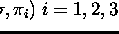 which we regard as the
chiral field and we say that the model
displays an O(4) symmetry. The field is used to represent
the quark condensate since they exhibit the same behaviour
under chiral transformations. The pions are very light particles and can
be considered approximately as massless Goldstone bosons.
The fermions become massive through the mechanism of symmetry
breaking and we are able to model the observed masses for the pions.
which we regard as the
chiral field and we say that the model
displays an O(4) symmetry. The field is used to represent
the quark condensate since they exhibit the same behaviour
under chiral transformations. The pions are very light particles and can
be considered approximately as massless Goldstone bosons.
The fermions become massive through the mechanism of symmetry
breaking and we are able to model the observed masses for the pions.
In the framework of this model we have calculated the effective potential at finite temperature and its evolution as a function of temperature and the scalar field which represents the quark condensate is given in figure 3.
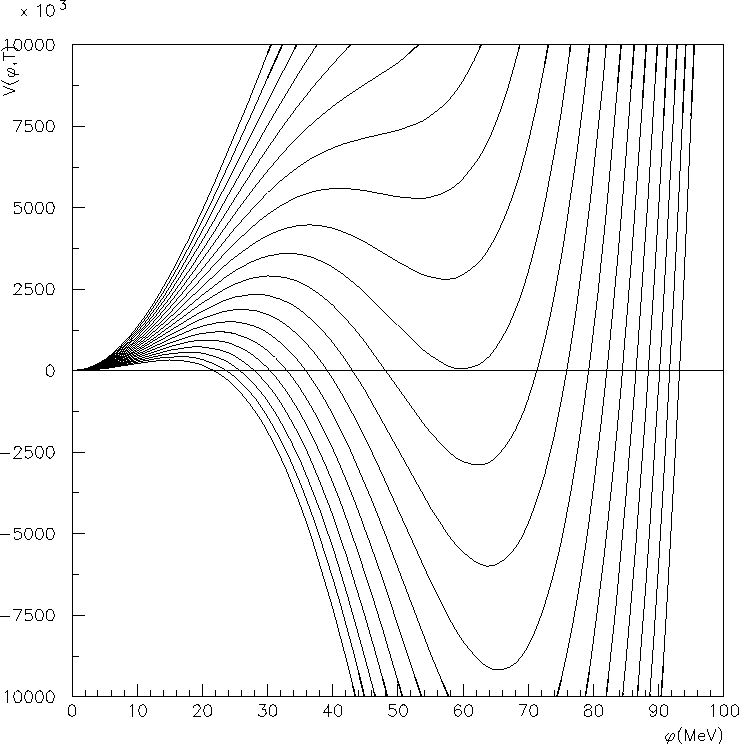
Figure 3: Evolution of the effective potential  for
the linear sigma model with temperature. At the transition temperature
there are two degenerate minima.
for
the linear sigma model with temperature. At the transition temperature
there are two degenerate minima.
At low temperatures the symmetry is broken, the potential exhibits local minimum at non zero value of the scalar field. The temperature where appear two degenerate minima is called the transition temperature. It is clear that at very high temperatures there is only one minimum and this is indication of restoration of the chiral symmetry since the quark condensate disappears